WhatsApp Has Quietly Become the Most Important Customer Channel
Yet Most Companies Didn’t Consciously Make This Shift
There are technological changes that arrive loudly.
And then there are those that quietly slip into everyday life - until they suddenly become business-critical.
WhatsApp clearly belongs to the second category.
What once started as a private messenger is now the most important touchpoint with customers for many companies. Inquiries, appointment scheduling, follow-up questions, complaints - everything runs through a channel that was never originally designed for professional use.
And that is precisely where the problem lies.

WhatsApp isn’t the problem. But its role within the company is often undefined.
When Customer Communication Emerges Without a Plan
In many businesses, the beginning of WhatsApp usage can be clearly traced back. A customer asks whether they can “quickly message via WhatsApp.” An employee agrees. It works. It’s faster than email. More personal than a form.
So WhatsApp gets used more frequently.
And one day, it becomes part of everyday operations.
What’s missing is the moment when someone pauses and asks:
What does this actually mean for our company?
Because with every message, a system grows that was never consciously designed. Chats are spread across private devices. Information isn’t centrally accessible. Responsibilities are implicit, not defined.
How a Lack of Structure Shows Up in Daily Operations
The problems rarely appear dramatic. Most of the time, they’re small situations that repeat themselves:
A customer sends an inquiry on Saturday - it’s seen but not answered. On Monday, they follow up - this time frustrated.
Two employees reply to the same customer independently - with different statements. The customer wonders who is actually responsible.
An important chat history sits on the private phone of an employee who is currently on vacation. No one else has access.
An inquiry is “briefly saved” to respond later - and disappears in the chat thread.
None of these situations is dramatic on its own.
But together, they shape the customer experience - and the trust in the organization behind it.
The Crucial Misconception: WhatsApp as a Side Channel
Many companies still view WhatsApp as an add-on. As something that runs “on the side.” But this assumption no longer reflects reality.
For many customers, WhatsApp is now:
- the first point of contact
- the fastest way to get an answer
- the place where trust is built
Or lost.
Precisely because WhatsApp is so direct, delays, inconsistent answers or silence have an even stronger impact.
Why a Lack of Structure Creates Real Costs
A lack of structure isn’t a theoretical issue. It shows up in daily operations in very tangible ways: duplicate replies, missed inquiries, unclear responsibilities.
But the real risk runs deeper.
If communication isn’t traceable, it can’t be improved. If it isn’t centralized, it can’t be scaled. And if it’s tied to individual people, it becomes a liability.
This doesn’t just affect efficiency - it affects growth.
Business-critical channels that are organized by chance slow companies down - even when the offering itself is compelling.
Why Unstructured WhatsApp Usage Is Also a Data Protection Risk
In addition to efficiency and responsibilities, there is another aspect that is often overlooked in daily operations: data protection.
Many companies get started with WhatsApp using the private messenger app - simply because it is already installed on the device. But this app is designed for personal communication, not for professional use.
When customer communication runs through private accounts and devices, situations quickly arise that are difficult to keep fully compliant in practice - for example, because data and chat histories are not centrally managed and processes such as access requests, deletion or user permissions effectively depend on individual employees.
The channel remains the same.
But the requirements for handling sensitive customer data increase.
Superchat: Bringing Structure to a Channel That Has Already Grown
This is exactly where Superchat comes in.
Not to change WhatsApp - but to professionalize how it is used.
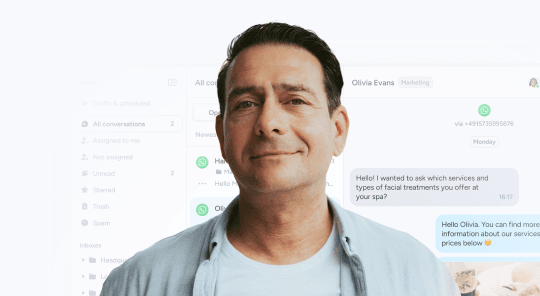
The platform bundles WhatsApp and other messengers into one shared inbox, making communication team-based, traceable and scalable.
Superchat uses the WhatsApp Business API, which is specifically designed for professional use, enabling companies to integrate WhatsApp into their customer communication in a data-compliant way.
This transforms an organically grown channel into a clearly structured process - without losing the personal nature of the conversation.
Superchat does not replace relationships.
It ensures they work - even in everyday operations.
How 9,000+ Superchat Customers Organize WhatsApp Differently Today
More than 9,000 companies across the globe now use Superchat as the central infrastructure for their customer communication.
The difference is not reflected in big promises, but in daily operations:
👉🏼 Inquiries land in one central place instead of on individual devices.
👉🏼 Teams can see what has already been answered.
👉🏼 Coverage works - even when someone is absent.
👉🏼 Recurring questions are handled automatically.
👉🏼 For customers, WhatsApp remains the same familiar channel.
For companies, it creates clarity, reliability and control.
Structure does not make communication less personal. It makes it resilient.
A Reasonable Next Step - Before WhatsApp Just “Runs Along” Further
Many companies already use WhatsApp every day.
The question is not whether they use the channel - but how consciously.
Those who understand what professional WhatsApp usage can look like quickly recognize where risks arise - and where untapped potential lies.
A short demo shows how existing processes can be structured - without disruption, without detours and without additional effort for the team.
Every additional day without structure reinforces a system that will be difficult to correct later.